Showing posts with label instructionaltechnology. Show all posts

Monday, June 23, 2014

Tadpoles Not Sharks

Today was the first day of our Summer teacher technology class. Cathy Wolinsky, Mike Arsenault, and I teach this class every June as soon as the year ends (the course runs for 3 days and then we finish up in the fall). Our syllabus includes ideas about teaching practice using technology, some tools, and then the teachers have time to work on projects, lessons, or units for the fall. We build in lots of time with support. Often we have 25 - 30 teachers, and the three of us can't get to everybody. That's where our students come in. We have 8 students that range from 7th - 11th grade come in and help. They have great ideas and are willing to be sounding boards as well as give feedback about the various projects. The last day of the course is always a share out of each person's project. Everyone walks out of that last day with tons more ideas they can use in their classroom. 

This year modeled a couple of things, which you can see in the description of day 1. We practiced doing a pre-assignment in Google Drive, introduced SAMR, and demoed an EdCafe based on the reading and writing each participant did to prepare for class. New this year, we added Tadpole Tank. This activity is modeled on the TV show Shark Tank (however Sharks are a bit intimidating, hence the name Tadpole Tank). After the EdCafe, we gave teachers an hour to put together a Pitch for what their final project will be. They created their own Google doc from this template. Because we had so many participants, we broke into two groups. Each group had a panel made up of 2 teachers and 2 students. Jim Moulton from Apple Maine joined us as a panelist, as well as some of our Lead Learners. Students took turns being on the panel. Everyone else was the audience. All audience members had access to the presenter's Google Doc. Each teacher made their project pitch to the panel. Audience members could type their feedback into the doc. After the pitch, the panel of 4 gave specific feedback and ideas. Audience members could also speak after the panel if they wanted. I might change this in the future. 


I have to say, this was one of the best activities we have done with teachers in awhile. The student feedback was particularly helpful and appropriate. It was fast paced and fun. I definitely changed the focus of the final project in a really positive way, and it helped set the work up for tomorrow. Students are in high demand because they gave specific feedback on a topic. Many teachers commented that their project has changed and that they are excited about the suggestions they got. Part of their assignment tonight is to rewrite their project proposal. 

I am excited about tomorrow... It's Edcamp (with student and teacher presenters) and then work time!

Wednesday, April 16, 2014

Bammy Award Nomination

I received an email today that I had been nominated for a Bammy Award. Thank you to my "colleague" who nominated me. You are a mystery, but I am so honored that you think I should be added to an incredible group of educators. I follow and learn from many of them an am looking forward to meeting new nominees that I will be adding to my PLN.

So now I ask that you vote. This will be exciting to see what happens next.

Wednesday, March 26, 2014

Wednesday, November 27, 2013

Seedlings Season 6: Hour of Code


Today we talk about the Hour of Code...


You can also get this as a podcast.

Happy Thanksgiving!

Sunday, November 03, 2013

Reflection on Honduras and "One Laptop Per Child"

I had the opportunity to participate in a teaching exchange in Honduras on October 12 -18. I was part of a team of 5 educators from The Maine International Center for Digital Learning. The team was Cathy Wolinsky (Yarmouth Elementary School), Laura Girr (Freeport Middle and High Schools), Abby Manahan, and Amy Wilmot (MICDL). Former Maine Governor and Senator Angus King and Bette Manchester founded MICDL in 2008 to support the development of promising educator practices, digital student resources, and international programs. MICDL works to create and sustain networks of educators, communities, international organizations , and university/school partnerships to promote technology-driven tools to personalize learning, encourage collaboration, and prepare students for the future.  

Background:
We have many visitors come to our high school to see our laptop program in action. I have written about this before. Representatives from Honduras and Surinam came last spring. The team included the Under Secretary for Technical Affairs of Pedagogical Education, Elia Del Cid and 2 members of the EduCatrachos Team, Patricia Rivera and Donaldo Ochoa. I was impressed with the questions they asked about 21st Century learning techniques and their commitment to professional development. Their pilot, which started in February 2013 in grades 3-6 , involves 70,000 OLPC computers running Sugar and Fedora (which allows them to connect to the internet). It is financed through the International Development Bank. The EduCatrachos Team invited us to come for two days of teaching and 2 days of attending a technology fair. Our role in the training was to share pedagogical strategies, support the integration of technology in areas of literacy and numeracy, as well 21st Century Skills such as leadership, problem solving, and creativity.

Prep:
We tried to prepare as best we could. The language barrier for preparing something like this was significant. Luckily Laura speaks Spanish, and the translator who had been with the team in Maine, Chris, helped us with planning. We really didn't know what prior knowledge and experience using technology to expect from our "students". At the time, we didn't know if there would be internet access or what version of machine they would be using. Thankfully, David, a member of the EducaTrachos team was at our hotel upon arrival with machines for us to learn on and his patient explaining made us feel better prepared. We also created a website to use with our participants.

Teaching:
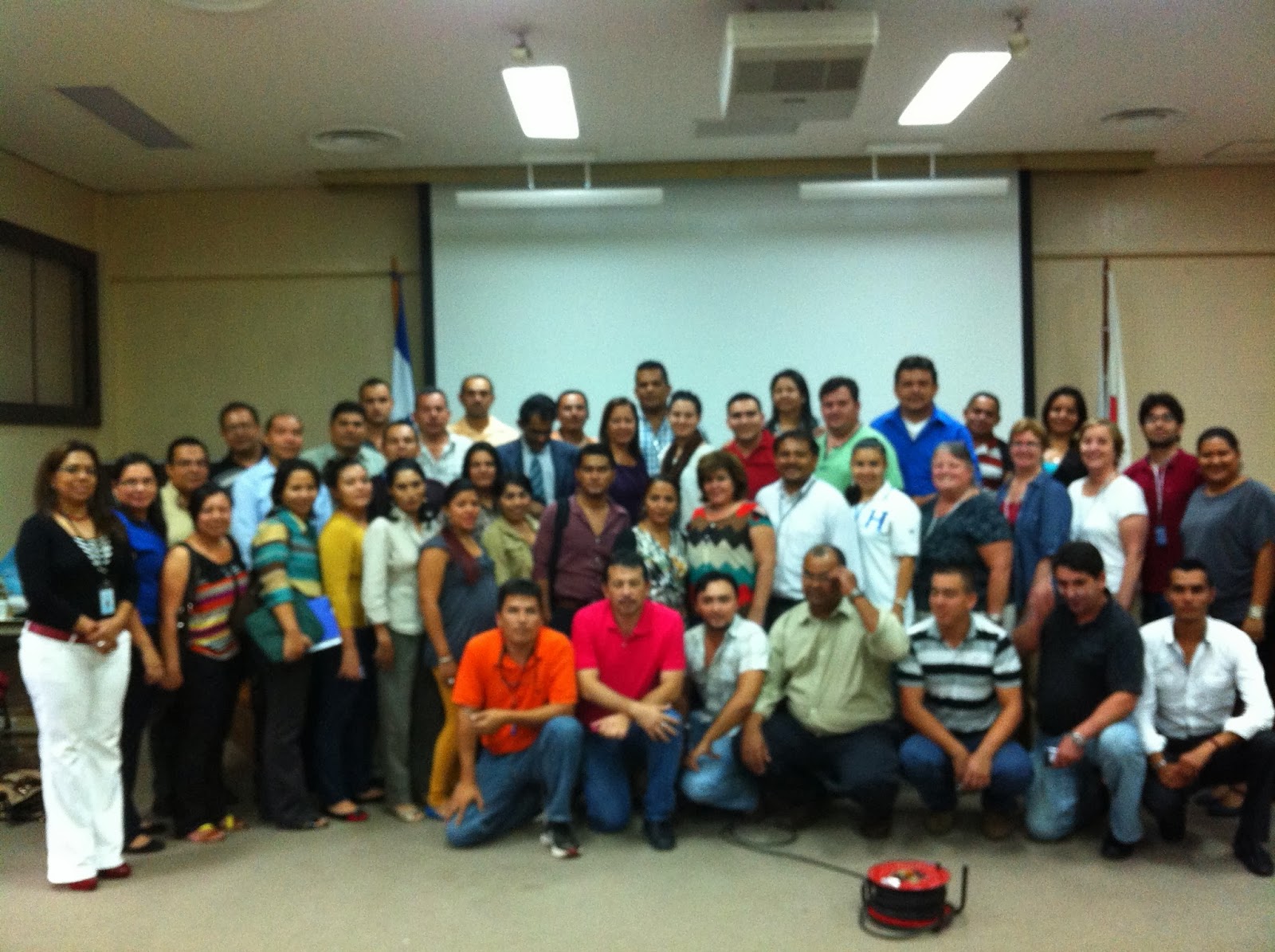
We met our translator, Diego, a college student who ironically had visited Portland, Maine as a child. For 2 days we met with about 45 teachers from Honduras, each picked as the technology lead for their school, They came from all over the country to attend. Also attending were 3 teachers from Panama, and 2 from El Salvador.
The modules we taught were:

• Storytelling - Literacy
• Numeracy Activities on XO
Scratch on XO
• KWL
• Unconference
• Smackdown or La guerra de ideas
Each module was introduced without technology and then enhanced using technology. One of our overall goals was to build a collaborative group that would stay connected after our time together. We started in nice straight rows and by the end of each day we had messy groups all around the room. Listening to the chatter and excitement made us think that this group will definitely continue their learning virtually through Facebook, Diigo, UStream, and other online tools.
Technology Fair:
Days 3 and 4 were spent at Chiminike,The Children's Museum, in Tegucigalpa. A wonderful celebration of student work, there were booths set up showing various school projects. Students used recycled materials to create puppets. They then made narrated videos of their puppet shows. Some were about teaching how to recycle. An exhibit on Denghe fever even had an OLPC laptop made out of styrofoam to take in to their community. Students are not able to take their laptops home.


Many students were using Scratch programming and Lego WeDo robots. There were robots everywhere! We saw many teachers being taught by students and many students working in small groups. The group from El Salvador did a very nice activity around introducing robotics to the teachers first by making circuit boards and hydraulics using syringes.  Next teachers put things together and then finally they introduced the robots. We presented our activity on storytelling and we presented our information about the Maine Learning Technology Initiative in Spanish. While we were presenting, students were videoing and taking pictures with their laptops. 


I really enjoyed working and learning with the students and teachers of Honduras. They have fully embraced new ways of learning using technology. The EduCatrachos team is amazing. Their knowledge and support services are critical to making the program a success. Every morning the latest information was posted at their website. They call and check in with each school once a week. They were giving individual support the entire 4 days. They know the machines inside out and were available to troubleshoot. As they finish year 1 of their project, I wish them all the best and success for the future! 

If you would like to see more pictures, my Flickr set is here. More pictures will be added to this group as well.

Thursday, April 04, 2013

GetIdeas.org Hangout on Professional Development


As part of the Featured Thought Leaders on GetIdeas.org, I was on a panel in Google Hangout with Julie Lindsay, Noble Kelly, Don Buckley, Michelle Bourgeois, Sylvia Martinez, and Mary Anne Petrillo. Their bios are here. The chat stream is available here.


Wednesday, April 03, 2013

Sunday, June 17, 2012

#Playingwithmedia: a continuation of learning


Thank you to Wes Fryer for asking me to participate as a guest blogger

I work at Yarmouth High School as the Instructional Technology Integrator. In March, we had the pleasure of having Wes come present a full day of learning #PlayingWIthMedia to our district . As part of our day, we had all teachers purchase, download, and read the first chapter of his book #playingwithmedia. Wes' presentation and follow up has had a huge impact on our work K - 12. Some of the projects done this year are featured in our Student Showcase.  

School wrapped up for students on Friday and on Tuesday we start our summer class for teachers. It's one of the favorite parts of my job. Along with my esteemed colleagues, Mike Arsenault and Cathy Wolinsky, we have worked very hard to help teachers integrate technology in to their classrooms during the year. As David Warlick wrote in his recent blog post Should Tools Drive the Learning?, we understand the delicate balance of teaching the tools and modeling classroom practice. It's tough because we want teachers to know about new tools they may not be exposed to in any other way. Students may know about the tool but don't have the experience to use it in the right ways for learning. We try to design our classes to meet somewhere in the middle.

This year will be a continuation of #playingwithmedia We have chosen to continue reading the section in the book on digital text to model how writing fits in with one of our district goals: Educators will design activities, assignments, and assessments that increase student engagement and learning.  We model certain tools on the first day and a half, and then we give teachers time to work. The teachers are able to try new things without the pressure of other school commitments. They propose a project that they will use in their classroom in the fall. They work collaboratively in groups for differentiation, reinforcement and collegiality. Students assist us. They are both knowledgeable about the tools teachers are using as well as great sounding boards for projects teachers are planning. Students learn what goes in to a planning a project and come away with an appreciation for the commitment that teachers give to their classroom practice.  We work for three full days  and then teachers go off for the summer. We reconvene in September for another work day. Teachers have had a chance to try some things in their classrooms with students and come to this work session to tweak or refine their projects. Then in October, we share the work that was done. Mike, Cathy, and I are always blown away by two things: first what amazing ideas they come up with, and second how different the project is from the proposal! We always say we learn so much from our own course! 

And that's what it's about: LEARNING. Feel free to come learn with us. And we'll be sharing as the week progresses. The website and blog will grow and change as we all contribute. We hope that you find it useful to your work. What will new things will you be learning this summer?

Friday, September 02, 2011

The 80 Best Twitter Feeds in Instructional Technology


Instructional technology is prevalent in college, whether you’re taking online classes or attending in person. Students today are using technology more than ever, and it only makes sense to use tech tools for a 21st century education. But innovations in instructional technology seem to pop up anew every day, and without your ear to the ground, it’s easy to miss important new developments. To help you keep up with the latest in instructional technology, we’ve highlighted 80 of the best Twitter feeds in the field. These Twitter users report, analyze, and even use instructional technology, sharing their own unique experiences that we can all learn from.

Thanks for including me on this list